
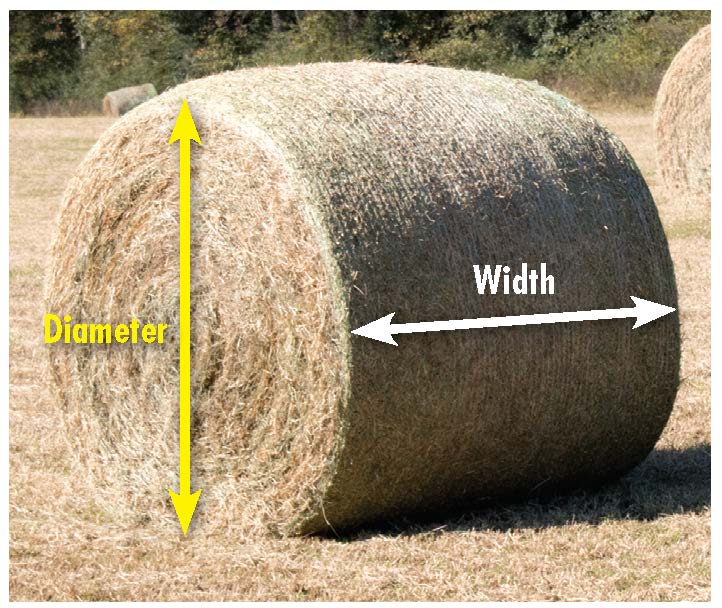
Short answer: A 4×5 round bale typically contains the equivalent of 15 to 25 small square bales, but this number is highly variable and depends almost entirely on the actual weight and density of both bale types. The single deciding question is: what is the precise weight of your specific round bale compared to your square bales? For instance, published agricultural resources often indicate a well-packed 4×5 round bale can weigh between 800 and 1,200 pounds, while small squares average 40-70 pounds.
That one fundamental question—the actual weight of your specific bales—resolves most of this decision. Everything below explains why this seemingly simple calculation has so much variability and how you can get to the most accurate answer for your operation.
What Are 4×5 Round Bales and Small Square Bales, Exactly?
To understand how many of one type fit into another, we first need to define what we’re talking about, beyond just their names. A **4×5 round bale** refers to a bale of forage (hay or silage) that is approximately 4 feet wide and 5 feet in diameter. These are large, dense bales typically weighing anywhere from 800 to 1,200 pounds, sometimes even more, depending on the forage type, moisture content, and baler settings. They’re designed for efficiency in large-scale operations, requiring mechanical equipment like tractors with front-end loaders to move.
**Small square bales**, on the other hand, are the traditional rectangular bales you might picture, commonly measuring about 14x18x36 inches (though dimensions can vary slightly). They’re much lighter, designed for manual handling, and typically weigh between 40 to 70 pounds each. These are favored by smaller operations, horse owners, or those who need to feed precise portions. The core challenge in converting between the two is that while dimensions give us a *volume*, they don’t tell us the *density* or *weight*, which are the true measures of forage content.
Why Bale Weight and Density Are Your Deciding Factors
The number of small square bales equivalent to a 4×5 round bale isn’t a fixed ratio because bale density and, consequently, weight, vary wildly. You can’t just compare volumes because a loosely packed round bale will contain far less forage than a tightly compressed one, even if they’re the same physical size.
The Impact of Forage Type and Moisture
Different types of forage compress differently. Alfalfa, for instance, tends to be denser than a fluffy grass hay. The moisture content at baling also plays a huge role; wetter hay is heavier and denser, but also carries storage risks. Published agricultural guidelines, such as those from various university extension services, consistently highlight that moisture content can cause bale weights of the same size to fluctuate by hundreds of pounds. This directly affects the amount of dry matter (actual feed) per bale, and thus, your equivalency calculations.
How Baler Settings Affect Density
Modern balers, especially round balers, allow operators to adjust the core and outer layer density. A farmer aiming for maximum efficiency might set their baler to produce very tight, heavy bales, while another might prefer slightly looser bales for easier feeding, even if it means more bales per acre. This operator choice means two 4×5 round bales from different farms, or even different fields on the same farm, can have significantly different weights.
Comparing Round and Small Square Bales: A Quick Table
If you’re trying to decide which bale type is right for you, or just understand the differences, this table lays out the key considerations.
| Characteristic | Small Square Bale | 4×5 Round Bale |
|---|---|---|
| Typical Weight (lbs) | 40-70 lbs | 800-1,200 lbs (often up to 1,500 lbs for high-density) |
| Handling | Manual lifting, easy for one person | Mechanical equipment (tractor, skid steer) required |
| Storage Space | Stacks densely, efficient use of rectangular space | Less space-efficient due to cylindrical shape, requires more vertical clearance |
| Feeding | Easy to portion, minimal waste for small herds/individuals | Free-choice feeding, potential for higher waste without feeder rings |
| Cost per Ton | Generally higher due to more labor-intensive baling | Generally lower due to highly mechanized process |
| Spoilage Risk | Lower if stored properly indoors | Higher outer layer spoilage if stored outdoors without cover |
If you read only one thing on this page, read the “Typical Weight (lbs)” row. It’s the most critical variable when estimating equivalency.
Your Five-Minute Path to Calculating Bale Equivalency
Getting an accurate count isn’t hard, but it does require a bit more than a quick guess. Here’s a straightforward process:
Weigh a Representative 4×5 Round Bale: This is the single most important step. If you have access to a scale (livestock scales, truck scales, or even a heavy-duty pallet scale if you can safely load it), weigh one of your actual round bales. Don’t rely on published averages if you can get a real number. For example, let’s say your specific bale weighs 950 pounds.
Weigh a Representative Small Square Bale: Similarly, weigh a few of your square bales. They can vary even within the same cutting. Take an average. Let’s say your square bales average 55 pounds.
Perform the Simple Division: Divide the weight of the round bale by the average weight of the small square bale.Using our example: 950 lbs (round bale) / 55 lbs (square bale) = 17.27 small square bales.
So, in this specific scenario, one 4×5 round bale is equivalent to approximately 17 small square bales.
If Weighing Isn’t Possible, Use Informed Averages (with caution): If you absolutely cannot weigh your bales, you’ll have to rely on averages. Be aware that this introduces significant potential for error. Many agricultural extension offices, like those from the University of Kentucky, have published guidelines suggesting a 4×5 round bale can range from 800 to 1,200 lbs, and small squares from 40 to 70 lbs. If you must use averages, try to get a sense of whether your hay feels particularly dense or light compared to others you’ve handled.
I once had to calculate for a client who couldn’t weigh their new batch of hay. We used manufacturer specifications for the baler model they used, which indicated a typical density range for their forage type. Assuming a middle-of-the-road 1,000-lb round bale and 60-lb square bales, we got around 16.67, or 17 small squares. This practical calculation, though simple, highlighted how crucial knowing *actual* weights is for accurate feed planning and budgeting, even when you have to make an educated guess.
The Overlooked Pitfall of Relying on Average Bale Weights
Most guides will hand you a simple ratio or an average range for bale equivalency, like “15 to 20 square bales per round bale.” What they often skip, or bury, is the significant financial and nutritional risk of relying solely on these averages. The hidden limitation is that an “average” bale might not exist in your barn, and variations can be substantial enough to throw off your entire feeding program.
Consider this: if your 4×5 round bales consistently weigh 1,100 pounds, but you’re planning based on a 900-pound average, you’re underestimating your feed supply by over 20% per bale. Conversely, if your bales are only 800 pounds and you’re planning for 1,000, you’ll run out of hay much faster than expected. This isn’t just a minor calculation error; it directly impacts your feed budget, your livestock’s nutrition, and potentially your need for emergency hay purchases.
Many older or simplified guides don’t adequately emphasize the variability caused by modern baler technology, which allows for a much wider range of densities than in the past. Always treat published average weights as a snapshot, not a fixed number, and prioritize actual measurement whenever possible.
Integrating Bale Equivalency into Your Forage Strategy
Understanding the true equivalency between 4×5 round bales and small square bales is more than just a numerical exercise; it’s a cornerstone of effective forage management. By accurately knowing how much feed you have in different formats, you can make smarter decisions across your entire operation.
Informed Purchasing Decisions
Knowing the true weight-to-weight equivalency allows you to compare prices accurately. Instead of just comparing the price per bale, you can calculate the “price per ton” for both round and square bales, which is the only real way to assess cost-effectiveness. A round bale might seem cheaper upfront, but if its density is low, its cost per ton could be higher than expected. This insight helps you choose the most economical option for your needs, whether you’re buying local hay or exploring options like ordering bulk hay deliveries.
Optimized Feeding Programs
Precise equivalency helps you maintain consistent nutrition for your livestock. If you’re switching between feeding round bales and square bales, knowing the exact conversion ensures your animals receive the same amount of forage. This is particularly important for animals with specific dietary needs or those on weight management programs. It also allows for better inventory management, helping you predict how long your current hay supply will last and when you’ll need to restock, preventing gaps in feed availability.
Efficient Storage and Handling
While not directly about the number of bales, understanding the weight and density implications of each bale type helps you plan your storage. Knowing that a 4×5 round bale represents a significant amount of forage (and weight) means you’ll need appropriate equipment for moving and feeding, as well as robust storage solutions to protect your investment from spoilage, especially if stored outdoors. Check out resources on proper hay storage techniques to minimize waste.
Ultimately, the most reliable way to determine how many square bales are in a 4×5 round bale is to measure the actual weight of your specific bales.
Frequently Asked Questions
How much does a 4×5 round bale typically weigh?
A 4×5 round bale typically weighs between 800 and 1,200 pounds, though high-density balers and specific forage types can push this weight up to 1,500 pounds or more. The actual weight depends heavily on the type of forage, its moisture content at baling, and the baler’s density settings.
What is the average weight of a small square bale?
Small square bales generally weigh between 40 and 70 pounds. Factors like forage type (e.g., alfalfa tends to be heavier than grass hay), moisture content, and how tightly the baler was set can cause significant variations within this range.
Why do bale weights vary so much for the same size?
Bale weights vary greatly due to several key factors: the type of forage (e.g., alfalfa is denser than oat hay), the moisture content at the time of baling (wetter hay is heavier), and the baler’s settings (operators can adjust for looser or tighter compression). These variables mean that two bales of the same dimensions can have vastly different weights.
Is it more cost-effective to buy round bales or square bales?
Generally, round bales tend to be more cost-effective per ton of forage because their production is highly mechanized, reducing labor costs. However, this can be offset by higher spoilage rates if stored improperly or greater waste during feeding without specialized feeders. Square bales usually have a higher cost per ton but offer easier handling, precise feeding, and less waste. Always calculate the price per ton to make an accurate comparison.
Can I use volume to estimate how many square bales are in a round bale?
While you can calculate the theoretical volume of both bale types, relying solely on volume for equivalency is highly inaccurate. Volume doesn’t account for density differences. A loosely packed round bale might have the same volume as a dense one but contain significantly less actual forage. Weight is the only reliable measure for comparing the amount of feed.