
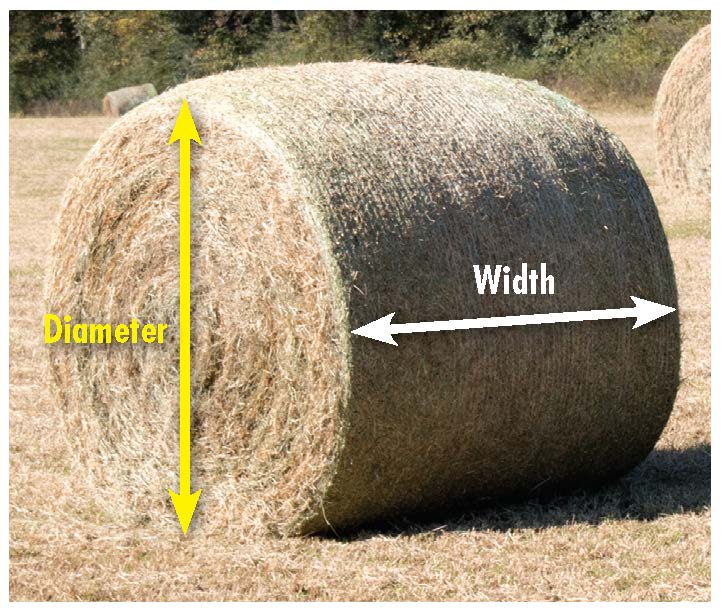
Short answer: There isn’t a single, fixed number of square bales in a round bale; it’s always a range. The precise conversion hinges entirely on the specific dimensions and density of both your round bale and the square bales you’re comparing. A common estimate, as often referenced by agricultural extension services, suggests a standard 5×5 foot round bale can be equivalent to 10-15 small square bales, but this number fluctuates significantly with hay type and baling pressure.
That one filter — the specific dimensions and density of your bales — resolves most of this decision. Everything below explains why this seemingly simple question has such a variable answer and how you can arrive at a practical estimate for your own operation.
What Determines the Conversion of Square Bales to Round Bales?
It’s not a fixed ratio because “a bale” isn’t a standardized unit of measure; instead, the conversion depends heavily on variables like the actual dimensions of each bale, its density, and even the type of forage it contains. Think of it less like converting inches to centimeters and more like comparing “a bucket” to “a cup”—you need to know the size of *both* containers.
Small square bales, often favored for horses and manual handling, typically measure around 14x18x36 inches (approximately 35x45x90 cm) and, when dry, weigh between 40-60 lbs (18-27 kg). Round bales, on the other hand, come in several common sizes like 4×4 feet, 5×5 feet, and 6×5 feet, with their weights varying wildly from 500 lbs to over 2,000 lbs (225-900 kg) depending on size and density. The primary question to ask yourself is: are you comparing small square bales to large rounds, or large square bales to different round sizes?
Which Specific Bale Sizes Are You Comparing?
The precise dimensions and density of both your round and square bales are the ultimate decider for accurate conversion, not a generic rule of thumb. Without knowing the exact weights and sizes, any conversion is merely an educated guess.
Here’s a breakdown of the common types and what influences their equivalence:
Small Square Bales: The Manual Standard
These are the workhorses of many small farms and horse operations. Their compact size makes them easy to handle by hand, stack efficiently, and portion out for individual animals. A standard small square bale, as mentioned, usually falls into the 40-60 lb range. This consistent size and weight (within a given batch) makes them a reliable unit for calculation.
Large Square Bales: Commercial Efficiency
Less common for direct comparison to round bales in terms of “how many,” large square bales are typically used in commercial operations where efficiency and transport density are paramount. These bales can weigh hundreds of pounds and require specialized equipment to move. While not directly relevant to the “how many small squares in a round” question, they highlight the spectrum of bale sizes.
Round Bales: The Bulk Option
Round bales are defined by their diameter and width (e.g., 5×5 feet). Their weight is highly variable, even for bales of the same stated dimensions, due to differences in baler settings, moisture content, and forage type. For instance, a 5×5 foot round bale of dry hay can commonly weigh between 1,000-1,200 lbs (450-540 kg), but this is merely an average. A wet or loosely packed bale of the same size could weigh significantly less or more.
Round vs. Square Bales: A Quick Comparison Table
To give you a quick reference, this table outlines typical equivalents based on commonly encountered bale sizes and average densities. Remember, these are estimates, and your actual numbers may vary.
| What Matters | Typical Round Bale Size & Weight (Dry Hay) | Equivalent Small Square Bales (40-60 lbs each) | Equivalent Large Square Bales (600-1000 lbs each) |
|---|---|---|---|
| Volume & Weight | 4×4 ft (approx. 500-800 lbs) | 8-15 | 1-1.5 |
| Volume & Weight | 5×5 ft (approx. 1000-1200 lbs) | 16-30 | 1.5-2 |
| Volume & Weight | 6×5 ft (approx. 1500-2000 lbs) | 25-50 | 2-3 |
If you need a quick mental shortcut, the 5×5 foot round bale row is your most common reference for a mid-sized operation.
How to Calculate Your Specific Bale Conversion in Five Minutes
The most accurate way to determine how many square bales are in *your* round bale is to focus on weight, as weight naturally accounts for both size and density. Here’s a simple, step-by-step path:
Weigh Your Small Square Bales: Grab a representative small square bale from your current batch. Use a livestock scale or even a heavy-duty bathroom scale (if you can manage the bale safely) to get its average weight. Let’s say it’s 50 lbs.
Weigh Your Round Bales: Similarly, weigh a representative round bale. This usually requires a truck scale or a specialized bale scale. If you’re buying hay, ask the seller for the average weight of their bales. For example, a 5×5 round bale might weigh 1,100 lbs.
Perform the Division: Divide the average weight of the round bale by the average weight of the small square bale.Example: 1,100 lbs (round bale) / 50 lbs (square bale) = 22 small square bales.
Consider Density Variations: Recognize that not all bales, even from the same field, are identical. Agricultural extension services often report that baling density can vary by as much as 30% depending on baler type, operator settings, and crop conditions at baling. If your round bales feel particularly loose or tight, or if the hay was baled wetter than usual, adjust your estimate slightly. A very dense, dry round bale will contain more actual forage, and thus more square bale equivalents, than a lighter, less dense one.
Factor in Hay Type and Moisture: Different forages (alfalfa vs. grass hay) have different densities even when dry. Also, hay baled with higher moisture content will be heavier, but that extra weight is water, not forage, so a direct weight-to-weight comparison might slightly overstate the *nutritional* equivalent if comparing very wet rounds to very dry squares.
This method gives you a much more reliable number than relying on generic volume estimates alone.
The Hidden Factor Most Guides Overlook: Density and Moisture Content
Many basic guides provide rough volume-based conversions, but they often skip or bury the critical impact of bale density and moisture content on the true equivalence. This isn’t just academic; it directly affects your feed budget, transport logistics, and even the nutritional intake of your animals.
A round bale that looks identical in size to another can weigh significantly more or less depending on how tightly it was baled and its moisture content at the time of baling. Consider two 5×5 foot round bales: one is packed tightly with dry, mature grass hay, and the other is loosely baled with slightly greener, higher-moisture forage. The denser, drier bale will contain substantially more actual forage—more dry matter—and thus be equivalent to a greater number of square bales in terms of feed value. The looser, wetter bale might weigh similarly or even more due to water content, but provide less usable feed. This distinction is crucial for accurate feed planning; you’re buying feed, not just volume. This disparity means that relying solely on external dimensions can be misleading, leading to under- or over-estimating your hay needs or the value of your purchase.
Applying This Knowledge to Your Farm or Livestock Operation
Understanding bale conversion is critical for efficient feed management, storage, and budgeting, whether you’re feeding horses, cattle, or small ruminants. It helps you make informed decisions when purchasing hay and planning your feeding strategy.
For operations feeding horses, small square bales offer precise portion control, which is excellent for managing individual horse diets and reducing waste. However, if you’re considering using round bales for horses, remember that while they offer bulk convenience, you’ll need to account for their larger volume and potential for waste without proper hay feeders or slow-feed nets. (For more on feeders, check out our guide on “Choosing the Right Hay Feeder”.)
Cattle operations, especially larger ones, often prioritize the efficiency of large round bales due to reduced labor requirements for feeding. However, for smaller herds or specialized feeding scenarios, knowing the square bale equivalent helps in comparing costs and ensuring adequate feed supply. Proper storage is another key consideration; round bales are often stored outdoors (with covers or elevated to prevent spoilage), while square bales typically require indoor, dry storage. (Learn more about optimizing your storage in our article on “Optimizing Hay Storage Solutions”.)
Ultimately, when you’re comparing prices, don’t just look at the cost per bale; calculate the cost per ton (or per square bale equivalent) to get a true comparison. This informed approach will save you money and ensure your animals are well-fed. The true equivalence boils down to the *weight* of the forage, making the specific dimensions and density of your bales the ultimate deciding factor in your calculations.
Frequently Asked Questions
Why do round bales vary so much in weight even if they are the same size?
Round bales vary in weight primarily due to differences in baling density (how tightly the hay is compressed), moisture content at baling, and the type of forage. A baler set for high density will pack more hay into the same volume, and wetter hay will naturally weigh more than dry hay, even if it contains less usable dry matter.
Is it generally cheaper to buy round bales or square bales?
Generally, round bales tend to be cheaper per ton of hay than small square bales. This is because they require less labor to bale and handle for large-scale operations. However, the overall cost-effectiveness for you depends on your equipment, storage capabilities, and labor costs. Small square bales can be more economical if you have high waste with round bales or need precise feeding.
How should I store round bales compared to square bales?
Round bales are often stored outdoors, but they should be placed on a well-drained surface (like gravel or pallets) and ideally covered with tarps to minimize spoilage from rain and ground moisture. Square bales, being more susceptible to moisture damage, require dry, indoor storage in a barn or shed to prevent mold and nutrient loss.
Can I feed round bales to horses?
Yes, you can feed round bales to horses, but with caution. Horses can overeat from a free-choice round bale, leading to weight gain or digestive issues. Using a slow-feed hay net or a specialized round bale feeder can help regulate intake, reduce waste, and minimize exposure to dust or mold.
What are the primary benefits of using small square bales over round bales?
Small square bales offer easier manual handling, precise portion control for individual animals, and more efficient stacking and storage in limited spaces. They are also ideal for smaller herds or for specific dietary needs where controlled feeding is essential, reducing waste compared to free-choice large bales.